How to start an LLC in Ohio, step by step
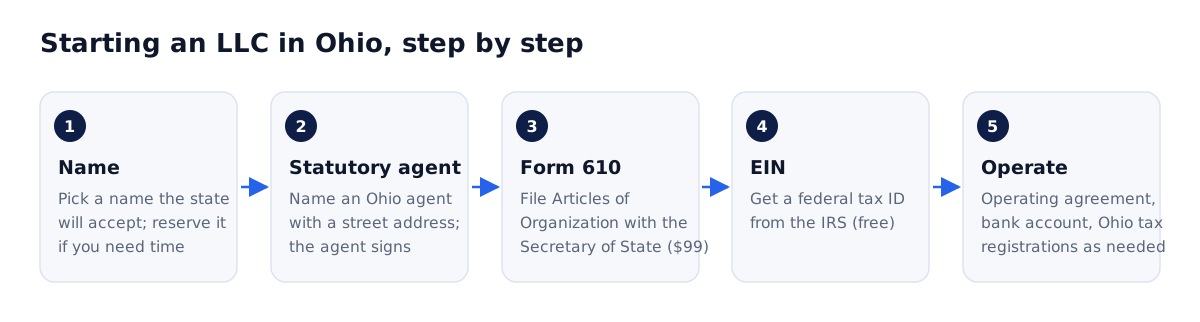
To start an LLC in Ohio, pick a distinguishable name, appoint a statutory agent, and file Articles of Organization (Form 610) with the Secretary of State for $99. Then get an EIN, put an operating agreement in writing, and register for the state and local taxes that apply to you.
Step 1: Choose a name that meets Ohio LLC requirements
Ohio's naming rules for LLCs are in ORC 1706.07. Two of them decide whether your articles get filed or sent back.
- The name must include "limited liability company" or one of the accepted abbreviations: "LLC," "L.L.C.," "limited," "ltd.," or "ltd" (ORC 1706.07(A)).
- The name must be distinguishable from names already on the Secretary of State's records. That list covers other LLCs, corporations, limited partnerships, limited liability partnerships, and registered trade names (ORC 1706.07(B)).
Search the name on Ohio Business Central before you do anything else. Check a few spellings, and check the name without the "LLC" ending, since an ending alone rarely makes two names different. If the exact name you want belongs to someone else, ORC 1706.07(C) lets you use it only with that holder's signed written consent filed with the state.
If you have the name but are not ready to file, a name reservation gives you the exclusive right to it for 180 days from filing (ORC 1706.07(E)). The state fee is $39. If you plan to file within the week, skip the reservation and file the articles. Our Ohio name reservation service handles the search and the filing if you want to hold a name now and form later.
Plan for the name you will actually use in public, too. If you will advertise under a brand that differs from the legal name, that is a separate trade name filing after the LLC exists.
Step 2: Choose an Ohio statutory agent for your LLC
Every Ohio LLC must keep an agent for service of process in Ohio at all times (ORC 1706.09(A)). Ohio calls this person or company a statutory agent; most other states say registered agent. The agent accepts lawsuits, subpoenas, and official notices for the LLC.
- An individual agent must be an Ohio resident, and the address on file is the street address of that person's primary residence in Ohio (ORC 1706.09(A)(1), (C)(1)).
- A business agent must have an Ohio business address, open during normal business hours, with someone authorized to act as agent generally present (ORC 1706.09(A)(2), (C)(2)).
- A post office box does not qualify.
- The agent signs a written acceptance of the appointment, and the state will not file the articles without it.
The agent's name and address go on the public record. If you serve as your own agent, your home address is what people see on the state's business search, and you need to be there to accept a process server.
Our Ohio statutory agent service is $49 per business per year from our office at 3416 Erhart Road in Litchfield. Sign up before you file your articles, so we can sign the acceptance the state requires. Documents we receive for you are scanned to your portal the same business day.
Step 3: File Articles of Organization (Form 610) online or by mail
Your LLC comes into existence when the Secretary of State files your Articles of Organization, Form 610, or at a later date you set on the form. The state fee is $99 under ORC 111.16(F), whether you file online or by mail.
| Filing method | How it works |
|---|---|
| Online | Ohio Business Central (OhioBusinessCentral.gov). Card payment, no mail time. |
| Mail, regular service | Typed, single-sided form with a check or money order payable to "Ohio Secretary of State," to P.O. Box 670, Columbus, OH 43216. |
| Mail, expedited | P.O. Box 1390, Columbus, OH 43216, with the added expedite fee. |
| Walk-in | The fastest expedite options are for filings hand-delivered to the Secretary of State's Client Service Center. |
Processing time
Form 610 lists regular processing at about 3 to 7 business days, depending on volume. For an added state fee you can expedite to 2 business days, or, for walk-in filings, 1 business day or 4 hours if received by 1:00 p.m. The form also offers preclearance: for a $50 fee the office reviews a draft and tells you within 1 to 2 business days whether it will be accepted.
Details that cause rejections
- Missing statutory agent acceptance.
- A name that is not distinguishable, or that lacks an LLC ending.
- A Social Security or tax ID number anywhere on the form. The state cannot file it.
- A delayed effective date more than 90 days after the state receives the filing.
Our Ohio filing guides walk through Form 610 field by field. If you would rather not do it yourself, have us file it: we check the name, prepare the articles with us as agent, and file them.
Step 4: Write an operating agreement (Ohio does not file it)
The articles are a short public filing. They say almost nothing about how the company runs. That is the job of the operating agreement, which you sign and keep. It never goes to the Secretary of State.
Ohio defines an operating agreement broadly: any valid agreement of the members, written or oral, or a written declaration of a sole member, about the company's affairs (ORC 1706.01(R)). So an Ohio LLC technically has one even if nobody wrote anything down. The trouble is proving what an oral agreement said years later.
A written agreement usually covers:
- Who the members are and what each contributed.
- How profits, losses, and distributions are split.
- Who makes decisions, and which decisions need a vote of all members.
- What happens when a member wants out, dies, or becomes disabled.
- How the company can be dissolved.
Single-member LLCs benefit too. A signed declaration shows a bank or a court that the company is run as its own entity, and it tells your family what happens to the business if something happens to you. Some banks ask to see it before they open an account. What yours should say is a question for your attorney; we file public documents and do not draft agreements.
Step 5: Get an EIN from the IRS
An Employer Identification Number is your LLC's federal tax ID. It comes from the IRS, not from Ohio, and the IRS charges nothing for it. Banks, payroll providers, and the Ohio Department of Taxation's registrations all ask for it.
- Apply after the state files your articles, so the legal name and formation date match the record.
- The online application must be finished in one session. It times out after 15 minutes of inactivity and cannot be saved.
- The person applying must be the responsible party or an authorized representative, with the responsible party's SSN or ITIN.
- The IRS limits applications to one EIN per responsible party per day, which matters if you are forming several LLCs at once.
- The online tool runs on set hours, Eastern time, and is not open around the clock.
When the EIN issues online, download and save the confirmation letter right away. If the responsible party has no SSN or ITIN, the application goes on paper and takes the IRS longer. Our EIN filing service handles both routes and puts the IRS letter in your portal.
Step 6: Register for the Ohio taxes that apply to your LLC
Forming the LLC does not register it for any state tax. Which registrations you need depends on what you sell and whether you have employees. The three that come up most:
Vendor's license for sales tax
Any business making retail sales that are subject to Ohio sales tax needs a vendor's license (ORC 5739.17(A)). You apply through the county auditor where you do business, or through the Tax Commissioner's registration system. The fee is $50 for each fixed place of business. Sellers without a fixed location who travel to make sales apply for a transient vendor's license, also $50.
Employer withholding
If your LLC has employees, it must withhold Ohio income tax from their pay each payroll period (ORC 5747.06(A)). Ohio law also has employers ask each employee for their school district of residence, because school district income tax may need to be withheld too (ORC 5747.06(E)). Register your withholding account before the first payroll.
Commercial Activity Tax
Ohio's Commercial Activity Tax applies to taxable gross receipts above an exclusion. For 2025 and later, businesses with $6 million or less in taxable gross receipts are excluded, and the annual minimum tax ended starting in 2024. A business that crosses $6 million registers through the Ohio Business Gateway within 30 days. Most new LLCs never reach that line, but keep it in mind as you grow.
Your accountant can tell you which registrations your business needs and whether others apply, such as unemployment insurance once you hire.
Step 7: Check local licenses and Ohio municipal income tax
The Secretary of State filing creates the LLC. It is not a permit to operate. Licenses come from whoever regulates your work and your location.
- Your city, village, or township: zoning approval for the location, building or occupancy permits, and any local registration for your type of business.
- Your county: health department permits for food service and similar work.
- State licensing boards: trades and professions that require a personal or company license before you take on work.
Call your city's zoning or building office before you sign a lease. A use that is not allowed at an address is much easier to discover before the move than after.
Ohio municipalities can levy their own income tax under ORC Chapter 718, and that tax can reach business net profits as well as wages. Depending on where you work and how the LLC is taxed, you may owe returns to more than one city. A business can elect to file its municipal net profit tax through the state Tax Commissioner instead of city by city (ORC 718.80). The election form is due by the 15th day of the fourth month of the taxable year and stays in place until you end it. Whether the election suits you is a question for your accountant.
Step 8: Open a business bank account and set up your records
Open the account in the LLC's exact legal name, as filed. Most banks ask for some combination of these:
- The filed Articles of Organization and the state's filing receipt.
- The IRS EIN confirmation letter.
- The operating agreement, especially for an LLC with more than one member.
- ID for each person who will sign on the account.
Run every business dollar through that account. Paying personal bills from it, or business bills from your personal card, blurs the line between you and the company, and that line is the reason you formed an LLC.
Keep one folder, paper or digital, with the founding documents: articles, filing receipt, EIN letter, signed operating agreement, any name reservation or trade name filing, and your tax account numbers. Add each amendment and agent filing as it happens. When a bank, landlord, or licensing office asks for proof, you can send it the same day.
If you will do business under a name other than the legal one, register it before you print signs or open accounts under it. Our Ohio trade name (DBA) service files it for $50 plus the $39 state fee.
Step 9: Stay compliant after your Ohio LLC is formed
Ohio LLCs do not file an annual report with the Secretary of State and pay no yearly state renewal fee to stay on the record. That makes the ongoing state requirements short, and easy to forget.
- Keep a statutory agent on record. If your agent dies, resigns, or moves out of Ohio, appoint a new one forthwith (ORC 1706.09(D)).
- Keep the agent's address current. If it changes, file the new address promptly (ORC 1706.09(E)) on a Statutory Agent Update, Form 521. The state fee is $25.
- Change agents on the same Form 521. Our guide to switching statutory agents covers who signs it and how long it takes.
- Amend the articles if the LLC's legal name changes. The state fee is $50.
- File your tax returns: state, municipal, and the CAT if you cross the threshold.
The agent requirement has teeth. If an LLC has no agent, or fails to file a required agent or address change, the Secretary of State mails a notice. If the problem is not fixed within 30 days, the articles are canceled without further notice. A canceled LLC can apply for reinstatement within two years (ORC 1706.09(L)).
Open state mail the day it arrives. Notices from the Secretary of State or the Department of Taxation are often the first sign that something on the record needs attention.
How much does it cost to start an LLC in Ohio?
The only required state fee to form an Ohio LLC is the $99 Articles of Organization fee. Everything else depends on how you do it and what your business does.
| Item | Cost | Required? |
|---|---|---|
| Articles of Organization (Form 610) | $99 state fee | Yes |
| Expedited state processing | Added state fee | Optional |
| Name reservation, 180 days | $39 state fee | Optional |
| Statutory agent | $49 per year with us; $0 if you serve yourself | An agent is required |
| Formation filing by us | $100 plus the $99 state fee | Optional |
| EIN | $0 from the IRS; $50 if we file it online | Usually |
| Vendor's license | $50 per fixed place of business | If you make taxable retail sales |
| Trade name | $39 state fee | If you use another name |
| Annual report | None in Ohio | No |
| How you form it | First-year total |
|---|---|
| File yourself, serve as your own agent | $99 |
| File yourself, name us as agent | $148 |
| We file the articles and serve as agent | $248 |
Totals leave out local licenses, professional fees, and taxes, which vary by business. After the first year, the state charges nothing to keep the LLC on record, so the recurring cost is the agent service. Our pricing page lists every fee.
More questions about starting an LLC in Ohio
Do I need a vendor's license for my Ohio LLC?
You need one if your LLC makes retail sales that are subject to Ohio sales tax. ORC 5739.17 requires a vendor's license for each fixed place of business, applied for through the county auditor or the Tax Commissioner's registration system. An LLC that sells only services not subject to sales tax may not need one. Your accountant can confirm whether your sales are taxable.
How much is a vendor's license in Ohio?
An Ohio vendor's license costs $50 for each fixed place of business under ORC 5739.17(A). A business with three locations needs three licenses. A transient vendor's license, for sellers who travel to sell without a fixed location, is also $50. These fees are separate from the $99 Articles of Organization fee and are paid to the tax authorities, not the Secretary of State.
Does a new Ohio LLC have to pay the Commercial Activity Tax?
Usually not, because businesses with $6 million or less in Ohio taxable gross receipts are excluded from the CAT for 2025 and later. The annual minimum tax also ended starting in 2024. A business that crosses $6 million must register through the Ohio Business Gateway within 30 days. Late registration can bring a penalty of up to $100 a month, capped at $1,000.
Is there a general business license for an Ohio LLC?
No single state form licenses every Ohio business. The Articles of Organization create the LLC, and licenses come from whoever regulates your work: your city or township for zoning and permits, your county health department for food service, and state boards for licensed trades and professions. Call your local zoning office before signing a lease to confirm the use is allowed.
Do I have to file city income tax returns for my Ohio LLC?
Possibly, depending on where you do business and how the LLC is taxed. Ohio municipalities can levy income tax under ORC Chapter 718, including on net profits. Under ORC 718.80, a business can elect to file its municipal net profit tax through the state Tax Commissioner instead of with each city. The election is due by the 15th day of the fourth month of the taxable year.
Can I set a future start date for my Ohio LLC?
Yes, Form 610 lets you set a delayed effective date up to 90 days after the Secretary of State receives the filing. You can also set an effective time. Without one, the LLC exists when the state files the articles. Owners often use a delayed date to start the company on the first of a month or at the beginning of a tax year.
Can Ohio review my Articles of Organization before I officially file?
Yes, Form 610 offers preclearance: for a $50 fee, the Secretary of State's office reviews a proposed filing and tells you whether it is acceptable. The review usually takes 1 to 2 business days. You still submit the actual filing and pay the $99 fee afterward. It is most useful for articles with added provisions or an unusual name.
Can one person start an LLC in Ohio?
Yes, one person can form an Ohio LLC and be its only member. Ohio law recognizes single-member LLCs; the statute that defines an operating agreement expressly includes a written declaration of a sole member (ORC 1706.01(R)). Form 610 needs only one signer, so the same person can be the organizer. The LLC still needs a statutory agent, which can be that person if they live in Ohio, or a commercial agent.
Does it cost more to file Ohio Articles of Organization by mail?
No, the $99 filing fee set by ORC 111.16(F) is the same whether you file online or by mail. Mail adds time, not cost: the form travels to Columbus, and paper rules apply, including typed, single-sided pages and a check or money order payable to "Ohio Secretary of State." Expedited processing costs extra either way, and walk-in delivery is required for the fastest options.
Does my Ohio LLC have to withhold school district income tax?
It may, once you have employees. ORC 5747.06(E) has Ohio employers ask each employee for their school district of residence so school district income tax can be withheld where it applies. Employees must answer accurately and report changes. An employer that asks and gets no answer is not penalized for failing to withhold. Your payroll provider or accountant can set this up.
Related Ohio guides
Need an Ohio statutory agent?
$49 per business per year. We file the appointment with the Ohio Secretary of State, scan documents the same business day, and call if a lawsuit goes unacknowledged.