How our Ohio statutory agent service handles service of process
Appoint us; we file it
Create your account, add the business, sign the consent, and pay $49 by card. After you e-sign, we prepare and file the appointment with the Ohio Secretary of State: a Statutory Agent Update if you're switching (the state charges $25 to record it, and we confirm that with you first), or the appointment in your articles if we form the entity for you. Nothing is filed until you sign. We confirm in your portal as soon as the state record shows us as your agent.
Filing your own formation papers? Name us with the entries below and we sign the acceptance. The filing guides cover each state form.
3416 Erhart Road
Litchfield, OH 44253
We receive
Delivery arrives at our office during business hours. Staff log the received date and time, the method (personal service, certified mail, courier), and photograph the envelope and any server affidavit. That record travels with the document for as long as we hold it.
We scan, classify, and notify
Every page is scanned at 300 dpi and published to your portal the same business day. A staff member confirms the entity match before anything is released to you. Each document is classified so you know at a glance what needs you now.
You acknowledge; we handle the original
Acknowledge in the portal and we record who did it and when. Then decide what happens to the paper: hold it, forward it with signature required (no handling fee, carrier charge passed through at cost, tracking in your portal), or let us securely destroy it at the end of its retention period: 30 days for routine mail, three years for state and tax correspondence. Originals from service of process are kept for seven years regardless.
Who sees what
Owners see everything. Employees and attorneys see only the entities and document categories you assign. A sensitive document outside someone's scope shows a permission notice, not a preview.
Ready to name us?
Create your account, add the business, sign the consent, and pay $49 by card. About five minutes.
Start for $49 a yearWhat is service of process in Ohio?
Service of process is the formal delivery of legal papers that tells someone they are being sued or ordered to act. A court case cannot go forward against a party until that party has been served. The papers are usually a summons and a complaint. Subpoenas, garnishment orders, and similar legal demands arrive the same way.
A person can be served at home or at work. A business has no home, so Ohio law gives it one fixed place to receive these papers: its statutory agent. Every Ohio LLC must keep one under ORC 1706.09, every for-profit corporation under ORC 1701.07, and every nonprofit corporation under ORC 1702.06. Ohio says "statutory agent" where most states say "registered agent." The job is the same.
The agent's name and Ohio street address are on file with the Secretary of State, where anyone can look them up. A plaintiff's attorney finds the agent there and has the papers delivered: by a process server in person, by certified mail, or by courier. Once they reach the agent, the business has been served, whether or not the owner has read them yet.
That is why the agent's side of the process matters so much. Service on the agent works the same whether the owner is on a job site, on vacation, or out of the country. The clock on the case does not wait for anyone to come back to the office, so the agent's job is to close the gap between delivery and the owner knowing about it.
How does a statutory agent appointment get on the state record?
Process servers and state agencies send papers to whatever agent the Ohio Secretary of State shows on file, so the appointment comes first. Ohio requires the agent's written acceptance with the appointment (ORC 1706.09(B)), so the record has our signature on it, not just your choice of name.
For a business already on file, you create a portal account, add the business, e-sign the appointment consent, and pay by card. We then prepare and file the Statutory Agent Update, Form 521, with the Secretary of State. The state charges $25 to record it, and we confirm that fee with you before we file. Nothing is filed until you sign.
For a new entity, the appointment is part of the articles. We can form the entity for you, or you can name us on your own articles using our filing guides and we sign the acceptance.
Your portal shows the appointment as Pending while the filing is with the state, then Active once the state record shows us. Until then, papers still go to whoever was on the record before, so ask your previous agent for anything delivered in the meantime.
What does a registered agent do for an Ohio business?
A registered agent does three things, and all of them come down to being findable and passing things on.
- Keeps an Ohio street address where delivery can be made. For an entity agent like us, the law requires a place customarily open during normal business hours with someone present who is authorized to accept service (ORC 1706.09(C)(2)). A P.O. box does not count.
- Accepts service of process and official notices on the business's behalf.
- Gets what it receives to the right people at the business, quickly and with a record.
Our office at 3416 Erhart Road in Litchfield is open Monday to Friday, 9:00 AM to 5:00 PM ET. That is the address on your state record, and it is where everything addressed to your business in care of its statutory agent arrives.
What happens if a business does not have a working agent? Under ORC 1706.09(H), a party who cannot find the agent can file an affidavit with the Secretary of State and serve the business through the Secretary of State instead, who forwards the papers by certified mail to the last address on file. The lawsuit still moves forward. The point of a reliable agent is that the papers come to you first, on the day they arrive.
What happens to a document at our office, step by step?
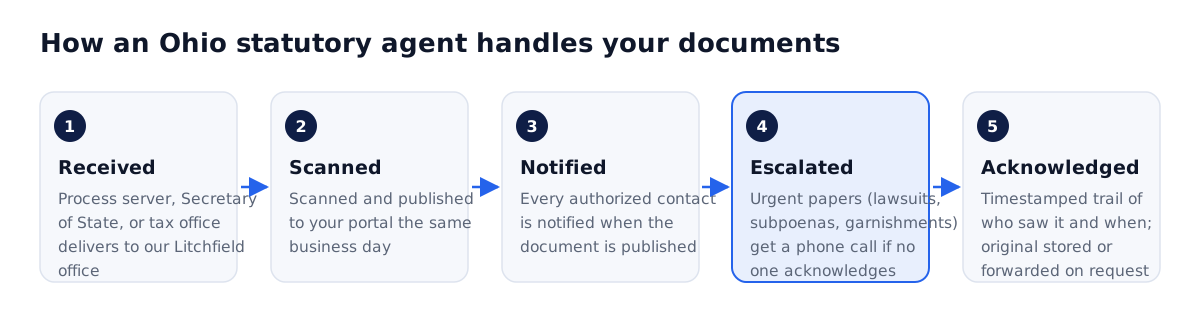
Here is the path a summons takes from the moment it reaches our door to the moment it is closed out in your file.
- Receive. Staff log the date and time it arrived and how it came: personal service, certified mail, or courier. We photograph the envelope and any server affidavit. That record stays with the document.
- Match. A staff member confirms the document belongs to your entity before anything is released. Names that look alike get checked against the entity on file.
- Scan. Every page is scanned at 300 dpi and published to your portal the same business day it arrives.
- Classify. The document is labeled urgent, attention, or routine so you can tell at a glance what needs you now.
- Notify. When the document is published, every contact authorized for that entity and category gets an email and a text.
- Escalate. If an urgent document is not acknowledged, we pick up the phone and call your contacts.
- Acknowledge. Someone at your business marks it received in the portal. We record who did it and when.
- Store or forward. You decide what happens to the original: we hold it for its retention period, ship it to you or your attorney, or securely destroy it when the period ends.
Routine mail follows the same path without the escalation step. It is scanned and published the same day, then rolled into your digest so it does not crowd out the documents that matter.
Every one of those steps leaves a timestamp. If anyone later asks when your business received a document and who saw it, the answer is in the document's acknowledgment trail.
Which documents are urgent, and which are routine?
Not everything that arrives for a business is a lawsuit, and treating it all the same buries the important pieces. We sort each document into one of three classes.
| Class | What it covers | How you hear about it |
|---|---|---|
| Urgent | Service of process: summonses, complaints, subpoenas, garnishments | Email and text to every authorized contact, then a phone call if nobody acknowledges |
| Attention | Ohio Secretary of State, Department of Taxation, Bureau of Workers' Compensation | Email and text to authorized contacts |
| Routine | Solicitations, chamber mail, vendor notices | Published to the portal and included in your digest |
What counts as service of process
- Summons and complaint: the papers that start a lawsuit against the business.
- Subpoena: an order to produce records or appear, sometimes in a case the business is not a party to.
- Garnishment: an order directing the business to hold money it owes someone else, often an employee's wages. Payroll usually needs to see it quickly.
Urgent documents escalate because they usually carry a deadline set by a court or the party serving them. We do not read those deadlines for you or track them. We make sure the right people have the document the day it arrives, and we escalate to a phone call if no one confirms it.
Does a statutory agent receive state and tax mail?
Yes. The Secretary of State uses the agent address on file, and other state agencies often write to it too. Ohio LLCs and for-profit corporations do not file annual reports, so state letters are not routine, and the ones that come are worth reading the day they arrive.
The most important example: if the state thinks a business has no valid agent on file, ORC 1706.09(L) has the Secretary of State send a notice, and if the problem is not fixed within 30 days of mailing, the LLC's articles or registration are cancelled without further notice. Corporations face the same rule under ORC 1701.07(M). A letter like that is exactly what the attention class exists for.
Department of Taxation and Bureau of Workers' Compensation letters are flagged the same way. We hold state and tax originals for three years, and the scan stays in your portal so your accountant can pull it up without asking you to dig for it.
What should you do when your registered agent receives a lawsuit?
Call your attorney. That is the first step and the most useful one. We do not give legal advice, and nothing in our notification tells you what the lawsuit means, whether it is valid, or how to respond.
What helps your attorney
- Open the document in the portal and acknowledge it so your team knows it is being handled.
- Send your attorney the scan, or give them their own attorney login so they can see it directly.
- Note the received date and delivery method in the portal record. Your attorney may ask when and how the business was served.
- If your attorney wants the paper original, request forwarding in the portal. We ship it with signature required.
If you believe the papers name the wrong business, or were meant for a company with a similar name, tell your attorney. Whether service was proper is a legal question, and we do not answer it. Our part is to deliver exactly what we received and keep an accurate record of how it came in.
Do not wait for the original to arrive before acting. The scan is published the same business day we receive the papers, and it is a complete copy of every page. The papers themselves say what the court expects and by when. Ask your attorney how much time you have.
Who at your business sees each document?
You choose. The portal has three roles, and each can be limited to specific entities and document categories.
- Owner: every entity, every document, billing, and users.
- Employee: only the entities and categories you assign. A bookkeeper can see tax mail without seeing lawsuits.
- Attorney: the entities you assign, including service of process, so outside counsel sees papers the same day you do.
Someone who opens a document outside their scope sees a permission notice, not a preview. Two-step sign-in is available for every user and is optional. You can add as many authorized contacts as you need, at no extra cost.
How long does a statutory agent keep original documents?
We keep paper originals in our office by category, then securely destroy them unless you ask us to forward them first.
| Category | Original kept for |
|---|---|
| Service of process | seven years |
| State and tax correspondence | three years |
| Routine mail | 30 days |
Forwarding has no handling fee. You pay the carrier's actual charge, shown in the portal before you approve the shipment. Scans stay in your portal while your account is open, along with the receipt record and acknowledgment trail for each document.
If you move to another agent, your appointment with us stays active until the new agent is on the state record, and we keep accepting documents for you in the meantime. Documents we already received remain available to you, so the history does not disappear when the billing ends.
Questions about how a specific kind of document is handled? Call (877) 908-6122, Monday to Friday, 9:00 AM to 5:00 PM ET.
Service of process and statutory agent questions
Who signs for papers when a process server comes to a statutory agent?
At our office, a staff member accepts delivery during business hours and signs where the server or carrier requires it. We log the date, time, and delivery method, and photograph the envelope and any server affidavit. That record stays attached to the document in your portal, so you can always see exactly how and when the papers arrived.
What is service of process?
Service of process is the formal delivery of court papers, such as a summons and complaint, to the party being sued. It is how a lawsuit officially starts against that party. For a business, papers go to the statutory agent on file with the Secretary of State. Delivery to the agent counts as delivery to the business.
What happens if my registered agent receives a lawsuit?
We log it, scan it, and publish it to your portal the same business day, then notify every authorized contact by email and text. Lawsuits are marked urgent. If nobody acknowledges the document, we escalate to a phone call. We do not give legal advice or track response deadlines, so your next call should be to your attorney.
How will I be notified when documents arrive?
You get an email and a text the moment a document is published to your portal, which happens the same business day it arrives. Every authorized contact for that entity and category is notified. Urgent documents, like a summons, also trigger a phone call if nobody acknowledges them. Routine mail is published and included in your digest.
Does a registered agent receive regular mail?
Yes, we receive regular mail addressed to your business at our office. We scan and publish it to your portal the same business day, and it is classified as routine unless it is a state, tax, or legal document. Routine originals are kept for 30 days, then securely destroyed unless you ask us to forward them. Forwarding has no handling fee.
Can a lawsuit be served through the Ohio Secretary of State?
Yes, when the business's agent cannot be found or the business has not kept one. Under ORC 1706.09(H), the party suing files an affidavit and serves the Secretary of State, who forwards the papers by certified mail to the last address on record. If that address is stale, the business may not learn about the case in time.
What does acknowledging a document in the portal mean?
Acknowledging means someone at your business confirms they have received and opened the document. We record the person and the time, and that entry joins the document's trail alongside when and how we received it. For urgent documents, acknowledgment is what stops the escalation. Without it, the next step is a phone call from our office to your contacts.
Can you send the original summons to my attorney?
Yes, we can ship the original to any address you name, including your attorney's office. Request forwarding in the portal and you will see the carrier's actual charge before you approve it. There is no handling fee. Shipments go signature required, with tracking in your portal. Your attorney can also have an attorney login to see the scan immediately.
What kind of state mail does a statutory agent receive in Ohio?
A statutory agent receives letters from the Ohio Secretary of State, the Department of Taxation, and the Bureau of Workers' Compensation, among others. We flag those for attention and notify your authorized contacts by email and text. A Secretary of State notice about your agent record matters most: left unresolved for 30 days, it can lead to cancellation under ORC 1706.09(L).
How do you make sure a document goes to the right business?
A staff member confirms the entity match before any document is released to a portal. We check the name on the papers against the entity on file, which matters when two businesses have similar names. Only after that check is the document published and your contacts notified, and the receipt record shows when it was matched and released.