Ohio UCC search: how to find financing statements filed with the Secretary of State
The Ohio Secretary of State is Ohio's central filing office for UCC financing statements (ORC 1309.501). Search the debtor's exact legal name to see each filing's number, date, secured party, and collateral. Fixture filings on real estate go to the county recorder instead, and a filing lapses after five years unless it is continued.
What is a UCC-1 financing statement?
A UCC-1 financing statement is a short public notice that a lender or seller claims a security interest in a debtor's personal property. It is filed under Ohio's version of Article 9 of the Uniform Commercial Code, ORC Chapter 1309. "UCC-1" is the common name for the initial filing.
The notice is deliberately thin. Under ORC 1309.502(A), it is sufficient if it gives the debtor's name, the secured party's name, and the collateral it covers. The collateral can be described item by item or simply as "all assets" or "all personal property" (ORC 1309.504).
The financing statement is not the loan. The security agreement and the loan documents stay private between the parties. The public filing only tells the world to ask. It can even be filed before the security agreement is signed (ORC 1309.502(D)), but only with the debtor's authorization in a signed record (ORC 1309.509).
Filing is how most security interests in business equipment, inventory, and receivables get "perfected." Perfection largely decides who gets paid first if the debtor defaults. How priority works in a particular deal is a question for the lender's or buyer's attorney.
Where are UCC financing statements filed in Ohio?
With the Ohio Secretary of State, for nearly everything. ORC 1309.501(A)(2) makes the Secretary of State the filing office in all but a few cases. Those go to the county office that records mortgages.
| What the filing covers | Where it is filed | Statute |
|---|---|---|
| Equipment, inventory, accounts, and most other business personal property | Ohio Secretary of State | ORC 1309.501(A)(2) |
| Goods that are or will become fixtures, filed as a fixture filing | County recorder where the real estate sits | ORC 1309.501(A)(1)(b); 317.08(A)(19) |
| Fixtures, when the filing is not a fixture filing | Ohio Secretary of State | ORC 1309.501(A)(2) |
| As-extracted collateral, such as oil, gas, or minerals, and timber to be cut | County recorder | ORC 1309.501(A)(1)(a) |
| Collateral of a transmitting utility, including fixtures | Ohio Secretary of State | ORC 1309.501(B) |
| Titled motor vehicles and watercraft (other than dealer inventory) | Noted on the certificate of title, not by UCC filing | ORC 1309.311(A)(2), (D) |
Two other kinds of lien are often confused with UCC filings. Federal tax liens are filed with the county recorder where the property is located (ORC 317.09). Mortgages on real estate are recorded with the county recorder too (ORC 317.08). Neither appears in the Secretary of State's UCC search.
Which state's UCC records should you search?
Search where the debtor is located, which is not always where it does business. ORC 1309.301(A) says the law of the debtor's location governs perfection, and ORC 1309.307 sets the location.
- An LLC or corporation formed under a state's law is located in that state (ORC 1309.307(E)). An Ohio LLC's filings are in Ohio. A Delaware LLC that runs its whole business in Cleveland has its filings in Delaware.
- An individual is located at his or her principal residence (ORC 1309.307(B)(1)). A sole proprietor living in Ohio is searched in Ohio.
- A registered organization stays located in its home state even after it is cancelled or dissolved (ORC 1309.307(G)).
So before you search, confirm what kind of entity the debtor is and where it was formed. The Ohio Secretary of State Business Search shows that on the record's type line. Our Ohio business search guide explains how to read it.
Step 1: Get the debtor's exact legal name
UCC records are indexed by the debtor's name (ORC 1309.519(C)), so the name is the whole search. For an LLC or corporation, use the name on its most recent public organic record, such as its articles or a name amendment (ORC 1309.503(A)(1)). Copy it from the Secretary of State's business record, punctuation and ending included.
For an individual with an unexpired Ohio driver's license or state ID, the correct name is the one on that card (ORC 1309.503(A)(4)). A trade name alone is never a sufficient debtor name (ORC 1309.503(C)), so do not stop at the name on the sign.
Step 2: Search the Secretary of State's UCC records
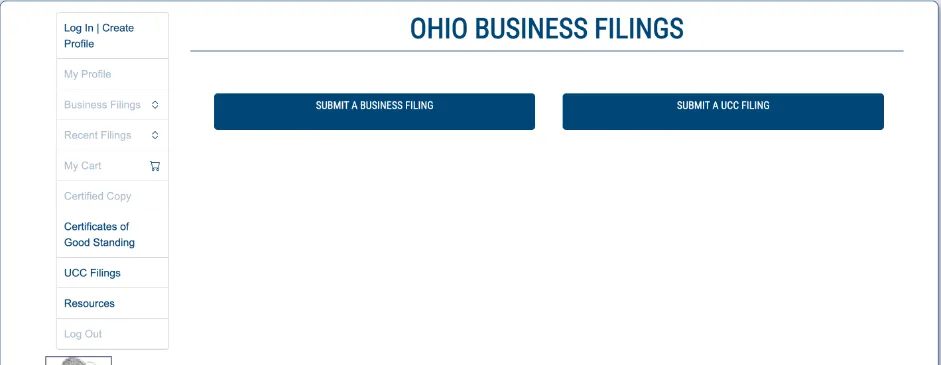
Go to Ohio Business Central at ohiobusinesscentral.gov, which opens the Secretary of State's filing portal at bsportal.ohiosos.gov, and open the UCC Filings menu. The Secretary of State says customers can "perform free searches of filings, including images." You can search by financing statement number, debtor name, or secured party name.
The same portal files UCC1, UCC3, and UCC5 records and takes UCC11 information requests, which are official searches by the filing office. Questions go to the Business Services division at [email protected] or 1-877-SOS-FILE.
Search the exact legal name first, then common variations. A filing with a slightly wrong debtor name still counts only if a search under the correct name would find it (ORC 1309.506(C)). The test uses the office's standard search logic. A lender should search the exact name; a buyer looking for trouble should also try the variations.
Step 3: Open each filing and everything attached to it
Each initial financing statement carries its own file number, and the office links every later record to it (ORC 1309.519(C)(1)). Open each result and read the chain: amendments, assignments to a new secured party, continuations, and terminations.
The last record in the chain tells you where the filing stands. A termination statement ends the filing's effect (ORC 1309.513(D)). A continuation keeps it alive. An amendment can add or release collateral or change the secured party.
Step 4: Check the county recorder for fixture filings and tax liens
If the deal involves real estate or things attached to it, search the county recorder in the county where the property sits. That is where fixture filings, mortgages, and federal tax liens are recorded (ORC 1309.501(A)(1); 317.08; 317.09).
Fixture filings are indexed like mortgages, under the debtor and the record owner of the land (ORC 1309.519(D)). Search the property owner's name in the recorder's index, not only the business that uses the equipment.
Step 5: Order copies or an official search if you need proof
If a lender, title company, or court needs proof of what is on file, ask the filing office for an official search response. In the portal, that is a UCC11 information request. Under ORC 1309.523(C), the office must report any unlapsed financing statement naming the debtor, with its filing date, time, and contents. You can ask it to include lapsed filings it still keeps.
On request, the office must issue the result as a record that Ohio courts admit "without extrinsic evidence of its authenticity" (ORC 1309.523(D)). That is what people mean by a certified UCC search. The office must answer within two business days of receiving the request (ORC 1309.523(E)). The search can be current only to a date no earlier than three business days before your request (ORC 1309.523(C)(1)).
What does an Ohio UCC search result show?
An Ohio UCC search result shows each filing's number, its filing date and time, the debtor, the secured party, and the collateral. It also shows the records filed against it since.
| Item | What it means | Statute |
|---|---|---|
| File number | The unique number assigned to the initial filing; it includes a check digit to catch typos | ORC 1309.519(A), (B) |
| Filing date and time | When the filing became effective; the five-year clock starts here | ORC 1309.519(A)(2); 1309.515(A) |
| Debtor name and mailing address | Who granted the security interest | ORC 1309.502(A); 1309.516(B)(5) |
| Secured party name and mailing address | Who claims the interest, or its representative | ORC 1309.502(A); 1309.516(B)(4) |
| Collateral | A description, or a statement that it covers all assets | ORC 1309.504 |
| Related records | Amendments, assignments, continuations, and terminations | ORC 1309.519(C)(1) |
A blanket "all assets" filing is the one buyers and lenders care about most. It means a secured party claims everything the debtor owns that Article 9 covers. Read it together with the secured party's name, then ask the debtor for the loan documents.
How long does a UCC filing last in Ohio?
Five years from the filing date (ORC 1309.515(A)). It lapses at the end of that period unless the secured party files a continuation statement first.
- A continuation can be filed only in the six months before the lapse date (ORC 1309.515(D)). One filed earlier is refused (ORC 1309.516(B)(7)).
- A timely continuation adds five years, counted from the date the filing would have lapsed (ORC 1309.515(E)). It can be continued again the same way.
- A filing that says it is part of a public-finance or manufactured-home transaction lasts 30 years (ORC 1309.515(B)).
- A transmitting utility's filing lasts until a termination is filed (ORC 1309.515(F)). A mortgage that works as a fixture filing lasts as long as the mortgage (ORC 1309.515(G)).
Lapse has teeth. When a filing lapses, the security interest becomes unperfected unless it is perfected another way. Against a buyer of the collateral for value, it is treated as never having been perfected (ORC 1309.515(C)).
Lapsed filings do not vanish from the search right away. The office may not drop the debtor's name from the index until one year after lapse (ORC 1309.519(G)). It keeps the record at least that long (ORC 1309.522(A)). Check the dates before you treat an old filing as live.
Why do buyers and lenders run a UCC search?
To find out who else already has a claim on the assets. A UCC search is a standard step before lending against, buying, or leasing business property.
- Lenders search the borrower before funding, to see whether another secured party already claims the same collateral.
- Buyers of a business or its equipment search the seller, to see whether the assets they are paying for are pledged to someone else.
- Landlords and investors search to see how much of a tenant's or company's property is already spoken for.
- Business owners search their own name to catch filings they did not authorize and old loans that were never cleared.
A search is only one part of due diligence. Pair it with the Secretary of State business record, the county recorder's records, and court dockets. Our guide to finding the owner of an Ohio LLC shows how those records fit together.
What if a paid-off loan still shows on your UCC record?
Send the secured party a signed demand for a termination statement. Once nothing is owed and no more credit is committed, ORC 1309.513(C) applies. The secured party then has 20 days after your demand to file a termination or send you one. For consumer goods, the secured party must act within one month on its own, or within 20 days of a demand (ORC 1309.513(A), (B)).
If the secured party does not act, ORC 1309.509(D)(2) lets the debtor authorize a termination statement that says the debtor authorized it. Talk to your attorney before you file one; the rules are strict.
A stale lien is only one thing a lender checks. If you are applying for credit, pull your Secretary of State business record too, and keep your statutory agent current so state notices reach you. Our Ohio statutory agent service is built for that.
What does an Ohio UCC search not show?
A UCC search shows notices, not balances. It cannot tell you how much is owed, whether a loan is in default, or whether it has been paid off without a termination being filed.
- Liens on titled vehicles and watercraft, which are noted on the certificate of title (ORC 1309.311).
- Real estate mortgages and federal tax liens, which are recorded with the county recorder (ORC 317.08; 317.09).
- Judgments, which are court records.
- Filings in other states, including the home state of an out-of-state LLC or corporation.
- Who owns the debtor. The filing names the debtor, not its members.
How much do Ohio UCC filings, searches, and copies cost?
ORC 1309.525 sets the fees. Filing and indexing a record costs $12. A filing-office response to a search request costs $20, whether the request is in writing or by another authorized medium.
The search fee drops to $5 if you ask only whether a financing statement names the debtor and who the secured party is. Copies of a financing statement, or of an assignment, cost $5 each on written request (ORC 1309.525(D)).
Searching online costs nothing. The statute does not require a fee for remote access searching (ORC 1309.525(B)). The Secretary of State's UCC page calls its online searches, including images, free. The fees above apply to filings, official UCC11 search requests, and copies. Recording a mortgage that doubles as a fixture filing carries the county recorder's usual fees instead (ORC 1309.525(C)).
Ohio UCC search and financing statement questions
Is an Ohio Secretary of State UCC search free?
Yes, searching online through Ohio Business Central is free, and the results include filing images. You can search by financing statement number, debtor name, or secured party name. An official search by the filing office, a UCC11 request, carries the statutory fee of $20, or $5 for a limited one (ORC 1309.525(B)).
How long does a UCC-1 financing statement stay effective in Ohio?
Five years from the filing date under ORC 1309.515(A). It lapses unless the secured party files a continuation statement in the six months before the lapse date. Each timely continuation adds five more years. Public-finance and manufactured-home filings last 30 years.
When can a UCC continuation statement be filed in Ohio?
Only within the six months before the financing statement would lapse (ORC 1309.515(D)). The filing office refuses a continuation filed earlier (ORC 1309.516(B)(7)). A timely continuation extends the filing for five years from the date it would otherwise have lapsed.
Where do I find a UCC fixture filing in Ohio?
With the county recorder in the county where the real estate is located, not the Secretary of State. ORC 1309.501(A)(1)(b) sends fixture filings to the office that records mortgages. They are indexed under the debtor and the record owner of the land, like a mortgage (ORC 1309.519(D)).
Why doesn't a Delaware LLC's UCC filing show up in Ohio's search?
Because it was filed in Delaware. Under ORC 1309.307(E), an LLC or corporation formed under a state's law is located in that state for UCC purposes, wherever it does business. Search the filing office of the state where the debtor was formed.
Does an Ohio UCC search show liens on a car or truck?
Generally no. ORC 1309.311 says a financing statement is not needed or effective to perfect a security interest in property covered by Ohio's certificate-of-title chapters. The lien is noted on the title instead. Inventory held for sale by a dealer is the main exception.
How do I get a UCC filing removed after my loan is paid off in Ohio?
Send the secured party a signed demand for a termination statement. Once nothing is owed and no more credit is committed, ORC 1309.513(C) gives it 20 days after the demand to file the termination or send it to you. If it fails to act, ORC 1309.509(D)(2) gives the debtor a fallback.
Can a lapsed UCC filing still appear in an Ohio search?
Yes, for a while. The office may not remove the debtor's name from the index until one year after lapse (ORC 1309.519(G)). It keeps the record at least that long (ORC 1309.522(A)). Check the filing date and any continuations before treating an old filing as live.
What is a certified UCC search in Ohio?
It is a search response the filing office issues as a record that Ohio courts admit without extrinsic evidence of its authenticity (ORC 1309.523(D)). The office must provide it on request, within two business days of receiving the request (ORC 1309.523(E)). Lenders and courts use it as proof of what was on file.
Does an Ohio UCC search show federal tax liens?
No, federal tax liens go to the county recorder where the property is located (ORC 317.09). They are not in the Secretary of State's UCC records. Search the recorder's index in each county where the business or its owner holds property.
Related Ohio guides
Need an Ohio statutory agent?
$49 per business per year. You file the appointment with the Ohio Secretary of State, or we file it for you. We scan documents the same business day, and call if a lawsuit goes unacknowledged.